


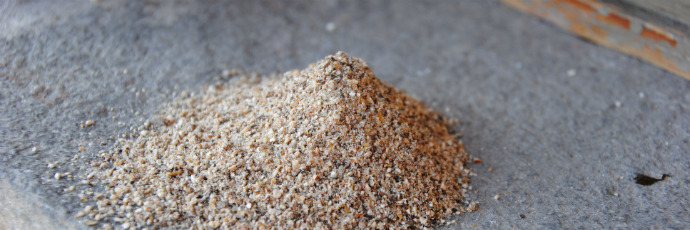
Saawa
Among the indigenous Wayuu communities of Guajira, in northern Colombia, saawa is a type of flour that can be made of various seeds, legumes and even fish. This product acts as a meal substitute particularly to be used when away from home. The flour can be made from seeds of corn, cowpeas, iguaraya seeds, cannonball fruit, squash, and other products, such as fish. The jumpirai is a fish that occasionally comes on to the seashore for a period. At these times, the indigenous people would take the opportunity to collect it very early in the morning, and then it would be roasted, in the same way as the seeds are toasted, and ground. To prepare saawa, one must be aware of the process used by the communities and associated with traditional knowledge to toast and grind the seeds, for which virgin river sand is always used. This makes it possible to toast the seeds and stop them burning as they toast. To make saawa, or harinita, first virgin river sand is selected (sand from the Ranchería River is usually used). The selected sand is sifted until it is very fine and it is then placed in the pot in which the seeds or other ingredients will be toasted. When the sand is hot, the ingredients are added, toasted until they turn a light coffee color and give off a toasted aroma. Then they are separated from the sand using a metal sieve and passed through a clean cloth to remove any remaining sand. When using seeds, only one variety is toasted at a time. Once all the seeds or fish are toasted, they are ground in a mill. In the past, they would be pounded with a stone. Once ground and mixed, ground panela or sugar is added to taste, and the saawa is then ready to eat. The flour produced by this process is traditionally stored in pumpkins, to be eaten dry or made into a porridge while shepherding or travelling, and could last for up to one month. It would also be added to soups. Saawa in its various forms is associated with a traditional way of eating produce from the Wayuu food heritage, such as beans, maize, squash seeds, cannonball fruit, various cactus seeds and the jampirai fish. In an environment that is so hostile to growing and keeping food, the indigenous people of these communities process these raw materials so it can be stored and eaten at any time, thus satisfying their daily dietary requirements. The Wayuu are nomadic people and on their long journeys across the land they had to have food readily to hand. Climate change has changed the land and marine fauna and flora of La Guajira. As there is no continuous production of the various products that could be processed, so the knowledge associated with its preparation and storage is being lost. There are few records of this kind of food product and this knowledge is fading from memory. Additionally, the version made with jumpirai once commonly made in coastal areas, is, for the most part, no longer eaten, as it is now very difficult to find the fish used to make it. Traditional knowledge associated with the processing of foods for storage and consumption is vitally important when proposing actions to mitigate the effects of climate change that are affecting agricultural production and food security. That is why this knowledge needs to be preserved and opportunities need to be created so that this legacy can be passed on to new generations, who, for various reasons, are currently unaware that it exists.
Back to the archive >

