


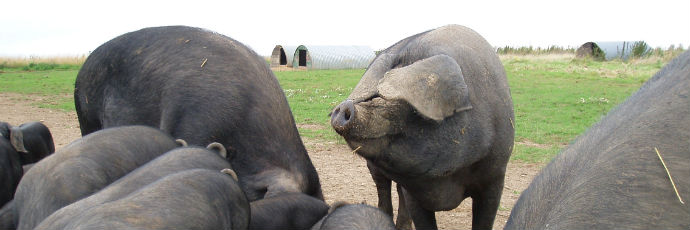
Large Back Pig, Devon Pig
A docile breed, the Large Black has lop ears and a long deep body. In fact the breed is renowned for its immense size. Parkinson in 1810 exclaimed ‘they are the largest of the kind I have ever seen, and as perfect a make as possible in pigs … their heads are large, with very long ears hanging down on each side of the face, so they can scarcely see their way.’ They are known as excellent mothers due to their placid temperament and thrive outdoors due to the colouring. It is often thought that its docile nature is a result of the fact that it can’t see because of the long ears. This particular breed is much appreciated for its succulent taste and eating quality.The Large Black has its origins in Devon and Cornwall. It was founded mainly on the native stock of the two counties, also incorporating the last remaining examples of the Small Black breed from East Anglia. It is Britain’s only all black pig and is sometimes known as the Devon. The breed has its origins in the Old English Hog established in the 16th and 17th centuries. By the late 1880’s there were two distinct types of Large Black, one to be found in East Anglia and the other in Devon and Cornwall. However the founding of the Large Black Pig Society in 1889 led to an increase in the exchange of stock between breeders in the two regions.In the early part of the 20th Century, Large Blacks were widely distributed throughout the country and were frequently crossed with Large Whites and Middle Whites to produce bacon and pork pigs. The Large Black breed was also very successful in the show ring at this time; at Smithfield in 1919, the Supreme Championship was awarded to a Large Black sow that subsequently sold for 700 guineas. The same year the breed outnumbered all other breeds at the Royal Show when 121 Large Black pigs were exhibited. Today there are small herds dotted about the country, but as a result of the general shift towards a leaner carcass and a prejudice against coloured pigs numbers are greatly reduced, with the decline starting in the 1960s and continuing on for a large part of the 20th century. The breed is on the Rare Breeds Survival Trust Watchlist. There are currently 335 sows registered in the UK as a whole.
Back to the archive >
