


Tamworth Pig
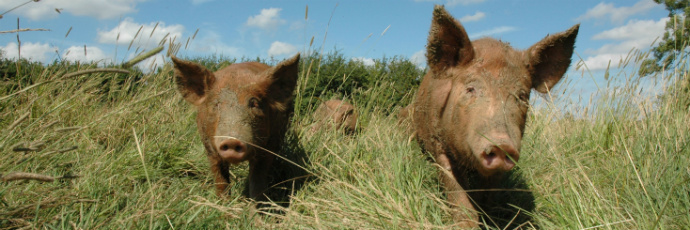
The Tamworth of today is easily identified by its golden red coat, long legs and pricked ears. The length of its snout also sets it apart, being the longest of all domestic breeds. Historically, this has not always been true. In the 19th century it was said to possess both shorter legs and smaller ears, often with a spotted red and brown color. Indeed old pictures of the Tamworth show it to have been anything from white or pale ginger with black spots to a ‘red and black’ pig. It closely resembled the picture painted by Low of the old ‘Berkshire’ Pig and bore great resemblance to today’s Oxford Sandy and Black Pig. The breed is characterised by having a neck and legs that are long, and by deep sides with narrow backs. Its ham structures are quite muscular and firm. The breed is also known for having excellent foot structure and a good skeletal system. The Tamworth is hardy, a trait it shares with all traditional English Breeds. This allows it to be kept in environments ranging from rough pasture to meadowland. The Tamworth is one of the great ‘dual purpose’ pigs producing stunningly good pork as well as equally tremendous bacon. In the mid 1990’s the Tamworth came top in a taste test carried out by Bristol University using both commercial and rare breed pigs in a scientifically controlled experiment. It was later suggested that further investigation should take place to establish just what it was that gave the Tamworth meat such a distinctive taste putting it way above all the other breeds. Traditionally, Tamworth has been a lean-meat, bacon producing breed. The color and texture of Tamworth meat is also most desirable. Tamworth meat is not soggy or white like commercially-raised pork. Instead, the meat has a firm consistency and more red color. The breed originated in the Midlands around Tamworth, the town that shares its name with the breed. It is the only native breed of pig in Britain which is red, and its ancestry is subject to several conflicting claims and theories. Today’s Tamworth is thought to be the most typical breed descended from the old indigenous species, the Old English Forest pig. It has maintained this status because at the end of the 18th Century, when many native breeds were ‘improved’ by crossing them with Chinese and Neapolitan stock, the Tamworth was not deemed fashionable and hence left alone. It is now therefore the oldest pure English breed and, as a result, it is also sometimes crossed with wild boar to produce distinctive gamey pork.During the 20th Century Tamworths were both exported and imported; an exercise vitally important to a breed with small numbers and potential inbreeding problems. During the early part of the century the imports were predominantly from Canada, one famous one being ‘Dollar Bobbie’ whose progeny resulted in the Rose line (no relation to the modern day Golden Rose line). Well over a century ago, when landowners, farmers, hotel keepers and cottagers kept pigs to cure their own bacon, the Tamworth enjoyed popularity due to its ability to produce white-fleshed carcases with long sides and big hams. As the breed’s name suggests, these pigs are traditionally remembered as cottagers’ pigs in the Midlands. The Tamworth is the Rare Breeds Survival Trust Watchlist, reflecting its status as a breed at risk. There are currently 493 pedigree sows registered as of 2011.
Back to the archive >
