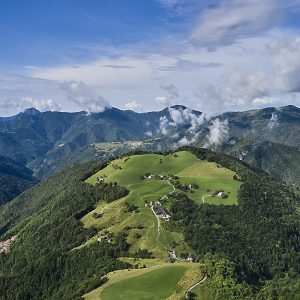
The Valvestino is a small valley located between Lake Idro and Lake Garda, bordering Trentino. Dominating the landscape is Monte Tombea (1,950 metres above sea level), which lends its name to an ancient raw-milk cheese traditionally produced on the Denai and Piani di Rest meadows at its foot. Here stand the characteristic haylofts with thatched roofs that slope all the way to the ground, likely of Lombard origin, where farmers would live with their families during haymaking and when the livestock returned from the alpine pastures. These mid-mountain stations, at around 1,200 metres, were occupied between March and June, when the animals were sent to the Tombea malghe. Some of the meadows were cut for hay and stored for winter, while others were grazed.
Isolated among the mountains and reachable only via a challenging road — often blocked by snow for weeks in the past — Valvestino remained under the Austro-Hungarian Empire until the end of World War I. Nevertheless, its small-scale trade in butter, cheese, wood, and charcoal was closely tied to the towns of Lake Garda. The first support for cheese production, through the establishment of rotational dairies, came from the Austrian administration. However, after World War II, these areas experienced strong emigration to Switzerland, Australia, and New Zealand. Depopulation began, and the number of producers dropped drastically. Today, the municipality of Magasa has around a hundred inhabitants, and the terraced fields once cultivated with wheat, corn, potatoes, and beans have almost entirely disappeared, replaced by forests.
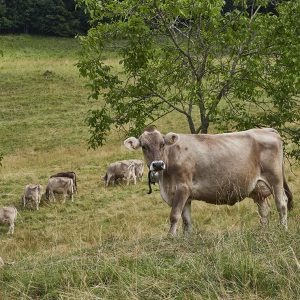
Tombea cheese is produced from May to September, when herds of cows — many of which are Brown Swiss (Bruna Alpina) — graze freely on the high plateau, feeding on fresh grass, a diet that greatly influences the quality of the milk and, consequently, the cheese. The high pastures of Valvestino are extraordinarily rich in forage species: a survey recorded over 140 varieties. In winter, the animals are fed with hay harvested from the local meadows during the summer months.
The cheese-making process begins by mixing the skimmed milk from the evening milking with the whole milk from the following morning in a copper vat. The milk is heated to 32–35°C before adding liquid calf rennet. The curd is then broken into grains the size of a rice kernel and cooked at 40–45°C. After about 30 minutes, the curd is removed from the vat and placed in molds (fascere) with a weight on top to facilitate whey drainage. For several days, the cheeses are dry-salted daily with coarsely crushed hand salt.
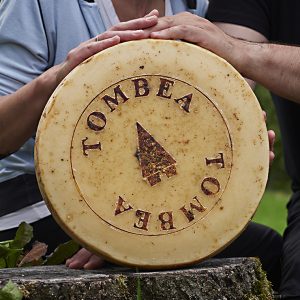
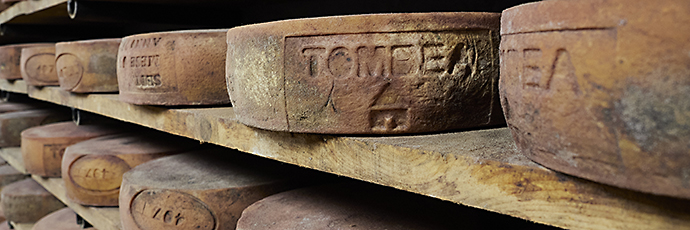
Tombea cheeses are large, weighing between 7 and 12 kilograms, cylindrical, with a hard but thin crust ranging from straw yellow to deep yellow. The aroma is intense and spicy, with notes of cooked milk, herbs, mountain essences, and dried fruit (especially hazelnuts). With ageing, meaty and broth-like notes emerge. The flavour is savoury, with a slightly spicy finish. Suitable for long maturation in dedicated cool rooms with moderate humidity, the cheeses are placed on wooden boards and turned daily. Tombea reaches its peak after 12 months and can age over 4 years.
Tombea cheese is rare outside its area of origin and is difficult to find on the market, as only two producers remain.
Back to the archive >The Presidium also seeks to support a local economy based on livestock farming and cheese-making — small in scale, but of fundamental importance for the territory. The municipality of Magasa supports local producers and has restored five alpine huts (malghe), which, though currently unoccupied, are intended to facilitate the establishment of new seasonal cheese-making stations.
Production area:
Municipalities of Magasa and Valvestino (Province of Brescia)
Seasonality:
Tombea cheese is available year-round.
Presidium supported by:
This project is funded by CAF America thanks to the generosity of FedEx.
Elia Eggiolini
Via Belvedere, 1
Moerna di Valvestino (Bs)
Tel. 347 3576563
eggiolini94@gmail.com
At Praa Magasa - Moerna di Valvestino from June 15 to September 15
Al Fienile di Omar Venturini
Via Dante, 18
Località Denai
Magasa (Bs)
Tel. 333 6182793
info@aziendagricolalfienile.it
Biagio Primiceri
Tel. 335 1593449
terreacquebresciane@network.slowfood.it