


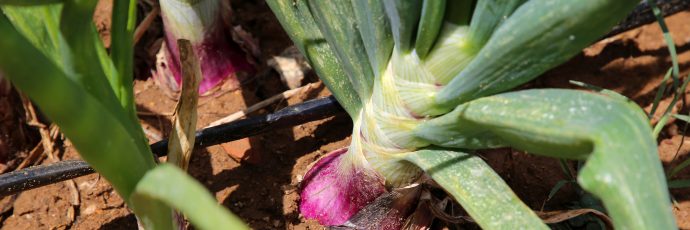
Cebola Roxa de Montemor-o-Novo
Montemor-o-Novo red onion is grown on the outskirts of Montemor-o-Novo (central Alente) by small-scale farmers. This is a traditional late-ripening variety, loved by local producers. The voluminous, round, slightly flattened bulb is purplish-red in color. The layers are thick, firm, pink, and moderately juicy. Montemor-o-Novo red onion has been endemic to the region for at least three generations, the seeds are handed down from father to son. It is well known for its sweet flavor able to enrich every raw and cooked food and it is the September city fair’s most valued product. In the “Reconnaissance of the Traditionally Cultivated Vegetable Heritage of the Municipality of Montemor-o-Novo”, the Montemor-o-Novo red onion is even described as a symbol of the region.
This onion has a very long shelf life: if harvested in late September it lasts from nine to twelve months. This is one of the reasons why it is largely sold at the September city fair, together with its very reasonable price. It has a sweet and pleasant taste, especially if it is harvested at its perfect ripening point, after a slow growth, so that all the acidity is converted into sugars. It is usually eaten raw, in salads, or added while cooking to give a special touch to many different foods. It also has the advantage of not making you cry when you cut it, due to the low acidity. It is generally grown using sustainable methods: fertilizers worsen its flavor and increase its unwanted acidity.
Montemor-o-Novo red onion is available from September and is sold fresh, in bunches, or by weight. It must be stored in a cool and dry place. If weather conditions permit, it is sown in mid-January or early February. After sowing, seed germination begins and at the end of this phase, the onions are ready to be planted, usually by mid-April or May. In August irrigation is interrupted to allow the onions to be ready for the harvest, in late August or early September.
Even if the Montemor-o-Novo red onion shows a deep connection with the culture of this community, the production quantity is still limited since each producer grows just a small number of plants. This traditional onion variety is therefore in danger of disappearing in the next few years. For this reason, the municipality is trying to enhance it, attracting new producers, encouraging sustainable cultivation practices, and encouraging consumption. In particular, the “Montemor-o-Novo red onion project” aims to safeguard its genetic heritage, increase the number of seeds available, provide guidelines to support new producers, and create a network to help them sell their products.
No Levantamento do Património Vegetal Tradicional Cultivado do Concelho de Montemor-o-Novo, levado a cabo pela associação Colher para Semear (2010), a Cebola Roxa de Montemor-o-Novo é descrita como a “que simboliza a região, é a variedade tradicional mais representada nas hortas em redor de Montemor-o-Novo; sujeita a grande procura, é a responsável por ter mantido um número interessante de agricultores ativos na sua produção. É considerada a cebola que possui o maior período de conservação, por esse facto continua a ser preferida na feira anual de setembro onde é transacionada a bom preço e em grandes quantidades".
É uma cebola que se come bem crua, ficando ótima em saladas e conferindo um sabor especial aos cozinhados. Tem ainda a vantagem de não fazer chorar, quando cortada. A adição de adubos, para estimular o seu crescimento, piora o sabor e aumenta a acidez. Esta é também uma cebola com uma duração em armazenamento invejável, de modo que, se colhida no final de setembro, já bem madura, mas ainda com bom tempo, ela durará entre 9 a 12 meses” (Fonseca & Cid, 2009).
Se as condições climáticas o permitirem, a Cebola Roxa de Montemor-o-Novo é semeada em meados de janeiro/fevereiro. Após a sementeira, inicia-se a germinação das próprias sementes. Após conclusão desta fase, os cebolos estão prontos para serem plantados.
Procede-se à preparação da terra e à elaboração de regos. O cebolo é plantado em meados de abril/maio, um pouco acima do fundo do rego, para que não fique encharcado quando é regado. Em agosto a rega é cortada, para permitir a secagem da Cebola Roxa. No final de agosto/início de setembro, está pronta para ser apanhada e comercializada.
A Cebola Roxa de Montemor-o-Novo é característica do concelho pelo menos há 3 gerações (mais de 150 anos). Não se sabe a idade exata da mesma, no entanto, a sua semente é guardada entre gerações e produtores. Conhecida pelo seu sabor adocicado, que concede aos cozinhados um sabor característico, é considerada a “estrela” da feira de setembro da cidade.
É um produto muito procurado pelos restaurantes locais e pelo consumidor final, mas é uma variedade que corre o risco de desaparecer devido à quantidade limitada de produção, uma vez que esta depende do número de produtores que produzem sementes, da quantidade de sementes e, consequentemente, da quantidade de cebolas plantadas.

