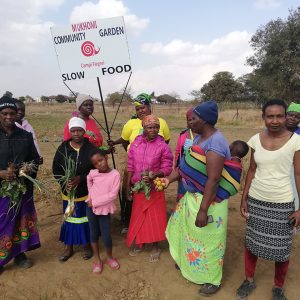
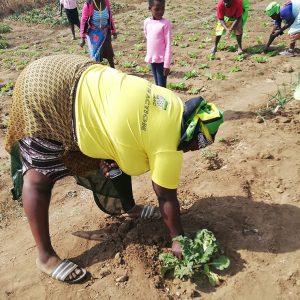
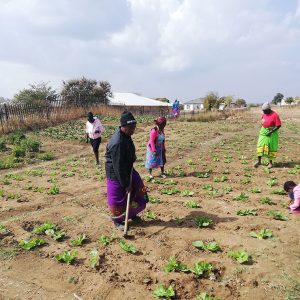
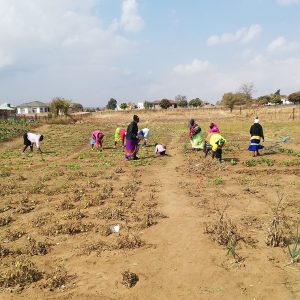
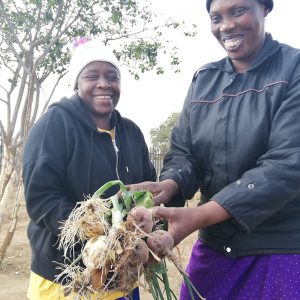
Mukhomi Community garden is a 3ha garden, with 32 women, operating in the school yard, with the agreement between members of the garden and the school. They have also been allocated 10ha land by the local traditional authority which they will use in the near future.
The garden operates throughout the year where they plant winter and summer crops.
Winter crops cultivated in the garden include: Spinach, Cabbage, Onions, Carrots and tomatoes.
Summer crops include; Peanuts, corn, watermelon, legumes, baby marrow, jugo beans amongst others.
They have purchased water tank, and other gardens tools such as hoes and rakes.
They sell the surplus of their harvest to local community of Mukhomi village, and they will form part of the earth market to be establish in the area.
Mukhomi Community Garden
Back to the archive >Products
- Onion
- Tomato
- Spinach
- Carrot
- Peanut
- Maize
- Bean
- Watermelon
- Pumpkin (C. maxima)
Slow Food in South Africa
In the “Rainbow Nation,” indigenous ethnic groups—the Zulu, Xhosa, Venda and Tsonga to name just a few—have over the centuries been joined by Portuguese, British and Dutch colonizers, then subsequently by waves of Asian immigration. South Africa has the highest number of people of Indian descent outside of India in the world. Hundreds of languages are spoken across the many diverse environments, from the temperate and Mediterranean-like West Cape to the arid Karoo and the subtropical northeast. But the country’s spectacular biodiversity is being destroyed by human activity. Agricultural biodiversity, for example, has been drastically reduced due to the widespread use of GMO seeds. Around 80% of the maize being cultivated is genetically modified. This type of agriculture is linked to the similarly industrialized production of foods high in sugar, salt, fat, additives and refined flour, creating eating habits that are leading to a rapid increase in heart disease and obesity. For these reasons, the Slow Food network in South Africa is working to highlight the relationship between food and health. Awareness is being raised among consumers about the importance of eating local, seasonal food, and the Slow Meat campaign is promoting more responsible meat consumption, with lower quantities, higher quality and the use of different cuts to avoid waste. It is not just consumers who are in need of better information. South Africa also has many small-scale farming families with little basic knowledge who urgently need technical training in order to help them develop sustainable agriculture practices. The 10,000 Gardens in Africa project is therefore of particular importance to the country’s development and the health of its people.
Garden Informations
| Type: | Community Garden |
| Surface in m2: | 20000 |
| People involved: | 32 |
| Coordinator: | Aliminah Makhubele |