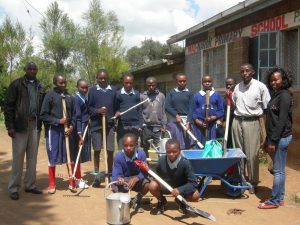
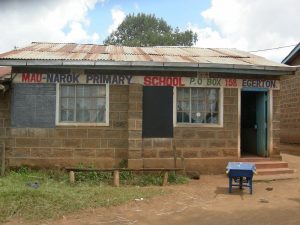
The garden is found in Mau-Narok village, NjoroSub county, Nakuru county. It is a public school with over 400 students, 50 of whom (25 boys and 25 girls) are directly involved in the gardening activities. The garden was established after the school was introduced to Slow Food’s projects, its activities and sustainable agricultural techniques during the 10,000 Gardens in Africa project training session where the teacher in charge of the group attended. The school administration set aside a 1/8-acre piece of land for the students to work in and learn from. The garden was initially part of the playground and nothing was cultivated on it. The students have planted the following crops: spinach, kale, coriander, amaranth, beans and black nightshade. They hope to diversify the land with different indigenous vegetables, grains, local fruits, herbs and medicinal plants. Animal manure brought from the students’ homes is used to fertilize the soil as they look forward to practically learn how make compost. Pest and disease management were also learned and will be implemented soon. Crops in this area are normally rain fed but during the dry season the crops are manually irrigated using watering cans. Some part of the harvest is shared among the students, some sold to teachers and school neighbors to generate some income, while the rest is stored as seeds.
Area
Mau-Narok Village, Njoro sub county, Nakuru county
Coordinator
Joyce Ruguru Gimisi