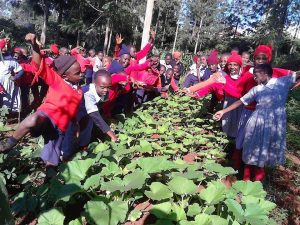
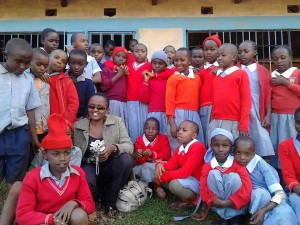
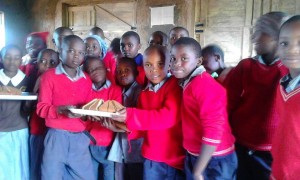
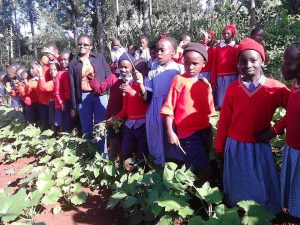
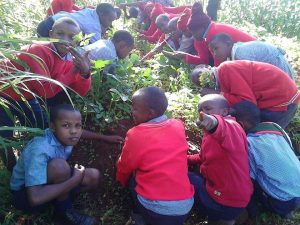
The garden is located in Gatanga primary school, Gatanga sub-location, Murang’a county. The school is public with a total number of 580 students (310 boys and 270 girls). Each year, the fifth class students, whose ages range from 9 to 11 years old, are involved in the gardening activities. At the far end of the school compound, is the 1/8 acre piece of land where these students learn sustainable agriculture techniques. They grow a wide range of crops such as spinach, kale, maize, spider weed, amaranth, okra, beans, spring onions, pumpkins and black nightshade. They also intercrop with bananas. Instead of using fertilizers that seems easy to work with, the students and the teacher in charge agreed on using animal manure that comes from their homes, as they practice compost making to ensure availability of enough manure. Diseases and pests are dealt with using natural remedies such as making plants extract from onions, garlic, pepper, Mexican marigold, and stinging nettle, among other useful plants. These plants are boiled together, allowed to cool, diluted with water and finally sprayed on the leaves of the crops to keep off pests. Intercropping and crop rotation are also other convenient techniques used mainly to repel pests and to break life cycles of insects respectively. Mainly the crops are rain fed but during the dry spell, small plastic bottles are used for drip irrigation. The produce harvested from the garden is shared among the students, some sold to the teachers to generate income and some stored as seeds.
Area
Gatanga sub-location, Murang’a county
Coordinator
Ann Muthee