Slow Food
  • Donate
  • Join us
  • Italian
  • English
Slow Food Foundation

Search

  • Home
  • About us
    • What is the Foundation?
  • What We Do
    • Slow Food Gardens in Africa
    • Slow Food Presidia
    • Ark of Taste
    • Slow Food Cooks’ Alliance
    • Earth Markets
    • What is the Narrative Label?
  • Get involved
    • Why Support Us
    • Italian Slow Food Presidia Sponsors
  • Multimedia
    • Publications
    • Video
    • Gallery
    • News archive
    • Photo archive
  • Contacts
Slow Food Foundation Slow Food Foundation
  • Home
  • About us
    • What is the Foundation?
  • What We Do
    • Slow Food Gardens in Africa
    • Slow Food Presidia
    • Ark of Taste
    • Slow Food Cooks’ Alliance
    • Earth Markets
    • What is the Narrative Label?
  • Get involved
    • Why Support Us
    • Italian Slow Food Presidia Sponsors
  • Multimedia
    • Publications
    • Video
    • Gallery
    • News archive
    • Photo archive
  • Contacts

Search

Home » 10.000 Orti in Africa » Meskerem Secondary School Garden

Meskerem Secondary School Garden

Back to the archive >

Ethiopia

Addis Ababa

Meskerem Secondary School is located in the center of the Ethiopian capital of Addis Ababa, in Arat Kilo, behind the presidential palace. It educates about 900 students in grades 9 and 10. Up the hill from the school is an ancient church called Baata Mariam, built by the late Emperor Menilik. Due to the concentration of old indigenous trees around the Baata Mariam church and the presidential palace, a small stream of clean water flows down the hill from the palace. Meskerem Secondary School garden shares a fence with Meskerem Elementary School, located right above it. The stream reaches Meskerem Elementary School, which last year became known for developing a school garden using the water. Meskerem Secondary School was influenced by the neighboring school’s gardening activities and requested access to the stream water, which in the past was sent to an underground tunnel. The school has plenty of land that can be used for growing food. The school director is very supportive of the land being used to cultivate vegetables.
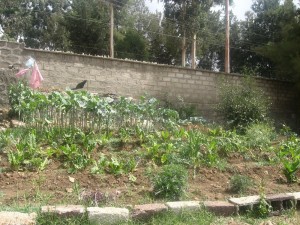
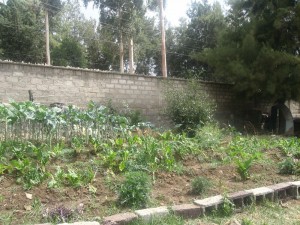
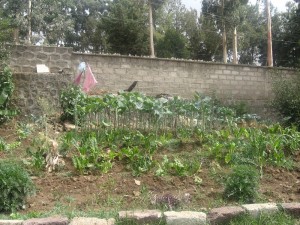
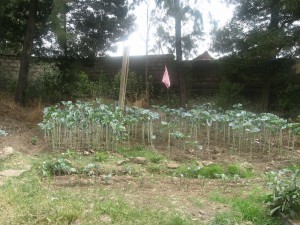
As soon as you enter the school, to the left you will see a small bed planted with Swiss chard and a local kale variety. After passing the office, you will find other beds planted with similar vegetables. These gardens are watered using the main water line. At the far end of the school, behind the football field, is a large piece of land (1000 m2) where the stream water coming from the palace passes through. This piece of land has been divided between the different school staff and is being used for the production of vegetables like local kale, lettuce, tomatoes, beetroot, carrots and chili peppers. The plan is to incorporate students into the garden activities through the environmental club. Etaferahu, the school staff member most active in the garden, participated in the Slow Food 10,000 Gardens in Africa training held in Addis Ababa in February 2016 and has made plans to involve 20 high school students in cultivating different types of vegetables. Varieties that will be cultivated are: Swiss chard (costa), local kale, carrots, chilly pepper, lettuce, tomatoes, beet root, cabbages and “ensete” (also known as false banana, a tree whose roots are the key staple food for the people of southern Ethiopia). The vegetables produced from the garden will be sold to students, school staff and parents at a very reasonable price. There are no school feeding programs in this school, probably because this is a secondary school. Just like in every school there are students from low income families who need support. The students needing support will be encouraged to participate in the garden activities and grow their own vegetables for home consumption.

Area
Arat Kilo, Addis Abeba

Coordinator
Tiginesh Mitik Beyene
Products

  • Curly kale
  • Lettuce
  • Chard
  • Chilies
  • Carrot
  • Beetroot
  • Tomato

Slow Food in Ethiopia

Slow Food has been active in Ethiopia since 2006, launching numerous projects in support of the most vulnerable local communities: nomadic herders, traditional forest beekeepers, wild coffee harvesters, indigenous groups and others. Through the Presidia and working with the communities, training activities have been run to strengthen the organization of small-scale producers and to promote and improve the quality of various foods like honey, camel milk, coffee, traditional grains and spices. Slow Food coordinators promote agroecological techniques—applying them in school and community food gardens—in the most diverse ecosystems, from forests and highlands to nature reserves and semi-arid zones. They are also working to save biodiversity and traditional knowledge. A number of educational projects have objectives that include the involvement of young people and women and awareness-raising around themes of strategic importance at a national and international level: the privatization of resources, the use of toxic chemicals in agriculture, the right to land. Educational materials have been produced in Amharic and Oromo, the main local languages. Every year, Ethiopian delegates participate in Slow Food’s international events (Salone del Gusto and Terra Madre, Indigenous Terra Madre, Cheese, Terra Madre Giovani and more) as well as other events thanks to collaborations with different organizations.

Garden Informations

Type:School Garden
Surface in m2:1000
People involved:920
Coordinator:Tiginesh Mitik Beyene
Sibling with:Table for Two International

Photos

Subscribe to the newsletter

Slow Food gratefully acknowledges funding support from European Union. The contents of this website are the sole responsibility of Slow Food and the CINEA is not responsible for any use that may be made of the information contained therein.
Slow Food - P.IVA 02743970044 - Privacy Policy - Cookie Policy - All rights reserved
Powered by Blulab