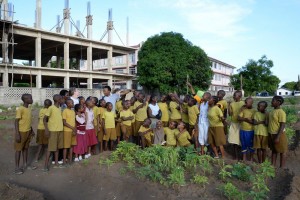
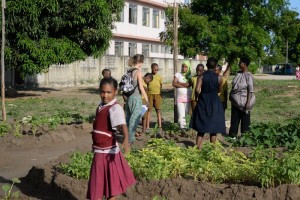
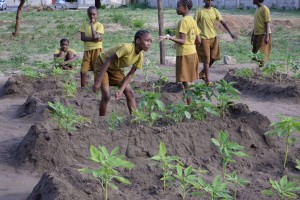
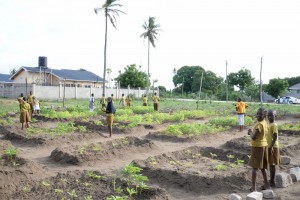
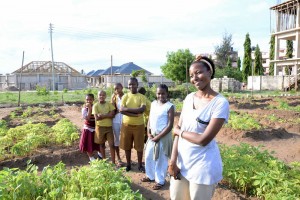
This ¼ acre garden is found within the school grounds that has 600 students, some of whom even sleep at school during the week. A group of 70 students from various classes are in the E-K club (a group involved in farming and self-economy activities) that cultivates the garden under the direction of a teacher. The children are divided into groups that are each responsible for a small section of the garden. Each morning before lessons begin the children come to the garden, and every night after school they water the plants and harvest the crops. One time each week the teacher who coordinates the gardening activities has a lesson in the garden. As the students are all different ages, peer-to-peer education practices are used. Local farmers supply the seeds to plant, while the school buys pollen to fertilize the soil. Some of the products in the garden are amaranth, pumpkins, sweet potatoes and black-jack. The crops are used in the school’s cafeteria (to make both lunch and dinner). One popular dish uses amaranth leaves (“kunde” in the local language) and sweet potato leaves: these are gathered, washed, cut and then cooked in a skillet with onions, oil and sometimes with tomatoes. The students also sometimes help prepare the dishes in the cafeteria. The gardening activities have the full support of the school’s administration (even the principle works in the garden) which wants to promote a kind of education that is not only theoretical but also practical.
Area
Dar Es Salaam
Coordinator
James Mkii