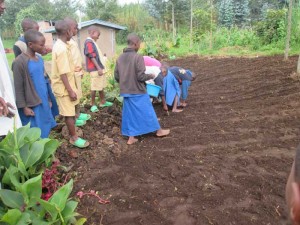
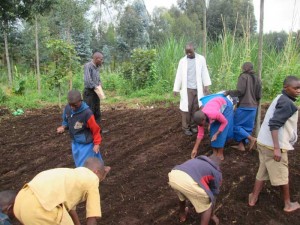
This 24m2 school garden is found in the Cyuve sector, in the Musanze District in the country’s north. The school currently has about 850 students and 15 teachers, but those who are principally involved in the garden’s cultivation belong to a club of 30 students. The school is situated near the valley and as such water is easily gathered. The soil is sandy and it is possible to cultivate several varieties of crops, among which there are: carrots planted in rotation with cabbage, potatoes, eggplant, and onions.
The garden was established in January 2015, thanks to the initiative of the Slow Food Ruhengeri convivium, following a report by the Nutrition Center which revealed a problem with malnutrition in the region. The school was contacted by Slow Food, through the Slow Food Ruhengeri Convivium, in January 2015.
The garden is also an important teaching tool, often used by the teachers to illustrate various points in their lessons. The garden serves to explain the different kinds of plants and to show how they produce in science classes.
The soil is fertilized with manure and compost that is made directly on site, while ash is used as a natural method to fight insects.
A part of the harvest is sold in the local market and the revenues are then used to cover the school’s small expenses and extra-curricular activities.
Area
Cyuve Sector, Musanze district, northern province
Coordinator
Prosper Uwiragiye