Slow Food
  • Donate
  • Join us
  • Italian
  • English
Slow Food Foundation

Search

  • Home
  • About us
    • What is the Foundation?
  • What We Do
    • Slow Food Gardens in Africa
    • Slow Food Presidia
    • Ark of Taste
    • Slow Food Cooks’ Alliance
    • Earth Markets
    • What is the Narrative Label?
  • Get involved
    • Why Support Us
    • Italian Slow Food Presidia Sponsors
  • Multimedia
    • Publications
    • Video
    • Gallery
    • News archive
    • Photo archive
  • Contacts
Slow Food Foundation Slow Food Foundation
  • Home
  • About us
    • What is the Foundation?
  • What We Do
    • Slow Food Gardens in Africa
    • Slow Food Presidia
    • Ark of Taste
    • Slow Food Cooks’ Alliance
    • Earth Markets
    • What is the Narrative Label?
  • Get involved
    • Why Support Us
    • Italian Slow Food Presidia Sponsors
  • Multimedia
    • Publications
    • Video
    • Gallery
    • News archive
    • Photo archive
  • Contacts

Search

Home » 10.000 Orti in Africa » Buiga Sunrise School Garden

Buiga Sunrise School Garden

Back to the archive >

Uganda

Gulu

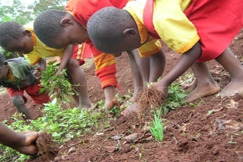
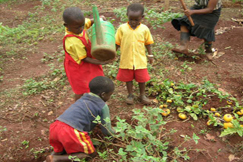
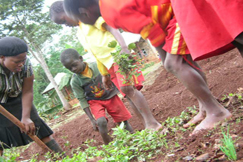
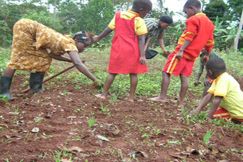
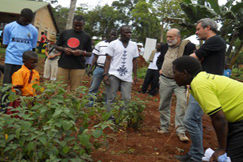
The Buiga Sunrise preschool is in the hills near Mukono and is reached by a dirt road. The food garden is behind the school’s yard and covers about half a hectare of sloping land, surrounded on two sides by natural forest. A small stream runs along the bottom of the garden. Teachers Noel Nanyunja, Naloongo Norah and Praise Lydia Nyago run the garden, involving 60 children aged between 3 and 6. All the children help with the different tasks, each choosing the activities they like best. For example, Salomon Walussimbi takes care of the liquid manure and can explain how best to mature it. Nandela Fatuma tends the soya seedlings, knows the sowing and harvesting periods and also knows that the soy can be used to make a nutritious porridge. The children know all the local varieties being grown and how to save seeds from each one. They harvest so many seeds that not only do they no longer have to buy them at the market, but then can even give some to other schools, who return the favor by giving them other seeds the next season.
Intercropped in the garden are red amaranth (bbuga in Luganda, the local language), two varieties of green amaranth (doodo), eggplant (nakati), corn, onions, cabbages, gooseberries, sorghum, carrots and manioc. Papaya, pineapple, avocado, jackfruit and mango grow around the perimeter and in the middle of the garden. One section is set aside for bananas and wild coffee plants. All of the harvested food is used for school meals, except for the coffee, which is sold and the profits used for school expenses.
The teachers organize various educational activities in the school. For example, together with the convivium’s cooks, the students learn to prepare traditional dishes like oluwombo (vegetables and meat with traditional seasonings, wrapped in banana leaves and steamed).
The garden was developed as part of the project Developing Innovations in School Cultivation (DISC), launched in 2006 by Edward Mukiibi, who is now the national coordinator of the Thousand Gardens project. Thanks to the great interest in the DISC project throughout Uganda, Edward and some students were invited to participate in the National Agricultural and Trade Show, which brings together farmers and producers from East, Central and West Africa.

Area
Buiga Sunrise preschool, Kyandazza village, Mukono district

Coordinators
Edward Mukiibi (Slow Food Mukono convivium leader), Serunjogi Rogers (assistant at the Buiga Sunrise school), Praise Lydia Nyago (preschool teacher)

This garden is twinned with “La Gabbianella” School Garden, Moncalieri, part of the Italian “Orti in Condotta” network:
www.slowfood.it/educazione/orti-in-condotta/scuola-dellinfanzia-la-gabbianella/
Slow Food in Uganda

Slow Food has been actively supporting the food communities in Uganda since 2006, working with many young volunteers and regional coordinators, creating Presidia and organizing agricultural activities as part of the 10,000 Gardens in Africa project. In 2015, Slow Food Uganda launched its national network, which now comprises over 10,000 activists. Nicknamed the “Pearl of Africa,” the country is rich in water and forest resources, with a tropical climate ideal for agricultural production and pasture-based livestock farming. Though landlocked, Uganda has plenty of flourishing trade links. Over 70% of the population works in the agricultural sector. Major foreign and government investment is concentrated on products for export: coffee, bananas, palm oil, sugar cane, maize, rice, beef and others. These industries are linked to serious human-rights violations. But the promotion of monocultures has terrible consequences for the natural environment and the sustainability of small-scale farmers, thanks to deforestation, the use of chemical fertilizers, pollution, the depletion of community resources and the disappearance of wild plants and less-resistant varieties. What’s more, it also encourages land grabbing and speculation on water and wetlands (rich in plant and animal biodiversity) and the introduction of supposedly more productive exotic livestock breeds, hybrid plants and GM seeds. President Yoweri Museveni—in power since 1986, following years of terrible civil war and dictatorship—and his government publicly promote foreign investment and the sale of national resources. Slow Food Uganda has built up a strong network in the central part of the country and a robust presence in the eastern and western regions and has developed a new strategy for the north. In the central-eastern areas, the focus has been on crops that are typical of the country’s traditional gastronomy and agroforestry systems: bananas, yams and coffee. To the north and west, work has been done on resilience and with indigenous groups, looking at ancient grain varieties and Ankole cattle, a native breed with striking lyre-shaped horns. In order to give a voice to farmers, defend the right to food and develop new and sustainable forms of local economy, Slow Food Uganda organizes annual events, like the Coffee Festival in February, workshops on fruit and vegetables in schools in April and June, the indigenous gastronomy fair in October and the Food Wise event in November. The Earth Markets in Mukono-Wakiso in the central region, Mbale in the eastern region and Lira-Amach in the northern region are held fortnightly. The association also participates in locally run civil-society platforms, involving everyone who supports the need to work simultaneously on agrobiodiversity protection, economic development and education through the proper management of resources. Site: www.slowfooduganda.org

Garden Informations

Type:School Garden
Surface in m2:60
Coordinator:Edward Mukiibi
Sibling with:La Gabbianella School, Moncalieri, Italy

Photos

Subscribe to the newsletter

Slow Food gratefully acknowledges funding support from European Union. The contents of this website are the sole responsibility of Slow Food and the CINEA is not responsible for any use that may be made of the information contained therein.
Slow Food - P.IVA 02743970044 - Privacy Policy - Cookie Policy - All rights reserved
Powered by Blulab