Slow Food
  • Donate
  • Join us
  • Italian
  • English
Slow Food Foundation

Search

  • Home
  • About us
    • What is the Foundation?
  • What We Do
    • Slow Food Gardens in Africa
    • Slow Food Presidia
    • Ark of Taste
    • Slow Food Cooks’ Alliance
    • Earth Markets
    • What is the Narrative Label?
  • Get involved
    • Why Support Us
    • Italian Slow Food Presidia Sponsors
  • Multimedia
    • Publications
    • Video
    • Gallery
    • News archive
    • Photo archive
  • Contacts
Slow Food Foundation Slow Food Foundation
  • Home
  • About us
    • What is the Foundation?
  • What We Do
    • Slow Food Gardens in Africa
    • Slow Food Presidia
    • Ark of Taste
    • Slow Food Cooks’ Alliance
    • Earth Markets
    • What is the Narrative Label?
  • Get involved
    • Why Support Us
    • Italian Slow Food Presidia Sponsors
  • Multimedia
    • Publications
    • Video
    • Gallery
    • News archive
    • Photo archive
  • Contacts

Search

Home » 10.000 Orti in Africa » PAORINHER Nursery and Primary School Garden

PAORINHER Nursery and Primary School Garden

Back to the archive >

Uganda

Pader

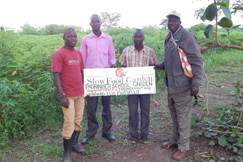
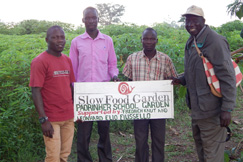
PAORINHER, the Patongo Orphan Infants’ Health Rehabilitation Center, is both a residential orphanage and a day centre supporting local orphans and vulnerable children in this war torn region, many of whom are HIV positive. The center provides daily meals, education, health care and activities and in 2010 a food garden was created to improve the variety and nutrition of the children’s diet and to provide them with an education in local agricultural practices. The idea of the garden came about when PAORINHER management realized that the children need to be equipped with relevant skills to produce nutritious foods, mainly fruits and vegetables, with their own hands rather than relying upon food aid. Since most of these children are in poor health, the garden is only used for educational purposes and the cultivation is done primarily by community volunteers, in particular the children’s guardians.

Garden location
Patongo Village, Patongo Municipality, Agago District, Northern Uganda

Coordinator
David Mwaka Okello
Slow Food in Uganda

Slow Food has been actively supporting the food communities in Uganda since 2006, working with many young volunteers and regional coordinators, creating Presidia and organizing agricultural activities as part of the 10,000 Gardens in Africa project. In 2015, Slow Food Uganda launched its national network, which now comprises over 10,000 activists. Nicknamed the “Pearl of Africa,” the country is rich in water and forest resources, with a tropical climate ideal for agricultural production and pasture-based livestock farming. Though landlocked, Uganda has plenty of flourishing trade links. Over 70% of the population works in the agricultural sector. Major foreign and government investment is concentrated on products for export: coffee, bananas, palm oil, sugar cane, maize, rice, beef and others. These industries are linked to serious human-rights violations. But the promotion of monocultures has terrible consequences for the natural environment and the sustainability of small-scale farmers, thanks to deforestation, the use of chemical fertilizers, pollution, the depletion of community resources and the disappearance of wild plants and less-resistant varieties. What’s more, it also encourages land grabbing and speculation on water and wetlands (rich in plant and animal biodiversity) and the introduction of supposedly more productive exotic livestock breeds, hybrid plants and GM seeds. President Yoweri Museveni—in power since 1986, following years of terrible civil war and dictatorship—and his government publicly promote foreign investment and the sale of national resources. Slow Food Uganda has built up a strong network in the central part of the country and a robust presence in the eastern and western regions and has developed a new strategy for the north. In the central-eastern areas, the focus has been on crops that are typical of the country’s traditional gastronomy and agroforestry systems: bananas, yams and coffee. To the north and west, work has been done on resilience and with indigenous groups, looking at ancient grain varieties and Ankole cattle, a native breed with striking lyre-shaped horns. In order to give a voice to farmers, defend the right to food and develop new and sustainable forms of local economy, Slow Food Uganda organizes annual events, like the Coffee Festival in February, workshops on fruit and vegetables in schools in April and June, the indigenous gastronomy fair in October and the Food Wise event in November. The Earth Markets in Mukono-Wakiso in the central region, Mbale in the eastern region and Lira-Amach in the northern region are held fortnightly. The association also participates in locally run civil-society platforms, involving everyone who supports the need to work simultaneously on agrobiodiversity protection, economic development and education through the proper management of resources. Site: www.slowfooduganda.org

Garden Informations

Type:School Garden
Coordinator:Albinus Ojok Lapok
Sibling with:Friedrich Knut and Leonhard Elio Fiussello

Photos

Subscribe to the newsletter

Slow Food gratefully acknowledges funding support from European Union. The contents of this website are the sole responsibility of Slow Food and the CINEA is not responsible for any use that may be made of the information contained therein.
Slow Food - P.IVA 02743970044 - Privacy Policy - Cookie Policy - All rights reserved
Powered by Blulab