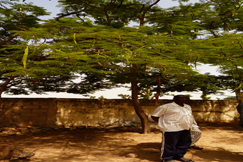
The Mabassa Fall public primary school was the first to be created in Ndande and is famous for having had some well-known political figures among its pupils. It now has about 500 students aged 5-14, who are all involved in an environmental awareness raising program managed by the Comité Interetat de Lutte contre la Secheresse au Sahel (CILSS).
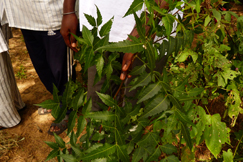
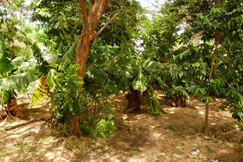
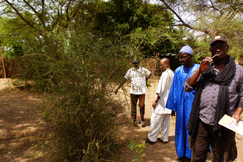
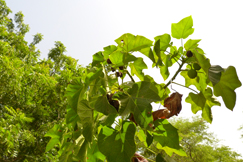
The school buildings are inside a fenced area, surrounded by flat plots used as fields, where some baobab trees grow. When crossing the school gate, the first things that strike visitors are the many large baobab and eucalyptus trees which shade the courtyard from the sun and the wind with their branches, and the rams kept inside a fence at the center of the school. A few steps away, some sheep are kept inside another fence built with recycled materials. Behind the school buildings is a small school garden (about 450 m²), initially launched within the Programme Regional de Formation-Information pour l’Environnement project. In the parcel, characterized by sandy soil, mango, papaya, tangerine and neem trees grow alongside turnips, tomatoes, carrots, white and red bissap, mint, sweet and bitter eggplants and moringa trees. The space is closed on two sides by the school fencing walls, and on the other two by a fence made with intertwined canes. An area of the garden is dedicated to the fruit plants nursery.
Yussou Ba helps the students with the garden work, where animal manure and neem oil is used to fertilize the soil. The garden harvest is sold to pay the school electricity bills.
Garden activities are connected to class lessons, so as to teach children to love and protect the environment.
Area
Mabassa Fall public primary school, village of Ndande, Kébémer department, Louga region
Coordinator
Mbaye Aw principal and Yussou Ba
This garden is twinned with the “Margherita Hack” School Garden, Padenghe sul Garda, part of the Italian “Orti in Condotta” network:
www.slowfood.it/educazione/orti-in-condotta/scuola-primaria-margherita-hack-di-padenghe-sul-garda/