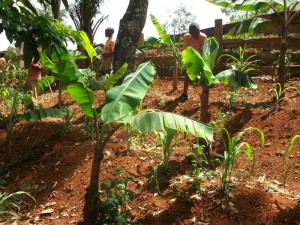
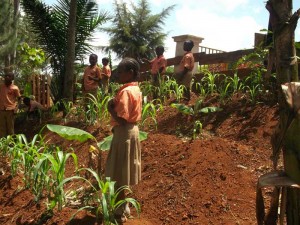
In Foumban, three kilometers from the nearest market, lies a market owned by the local school. Students are about 200, but only 30 (aged between 8 and 10) are involved in the garden activities, led by two teachers. During the school year (from the beginning of September to the end of June), students sow seeds, take care of flowers, clean, dig and fertilize the soil, weed, prune, and much more.
Only organic fertilizers are used: students collect chicken guano and other organic materials. After a few months, twice a year, they take everything to the garden. Seeds are bought or exchanged at the village, and rainwater is used to irrigate. The garden produces lemons, tangerines, grapefruits, cherries, avocadoes, mangoes, macadamia nuts, safoutier (Dacryodes edulis, an oil-plant), trees from the Bombacaceae family, neuphrier and much more. Trees include firs, pines, banana trees, palms, acacia, podocarpus (a conifer), eucalyptus, teak and apple trees. Grown flowers include hibiscus, roses, bougainvillea, dahlias and frangipani (shrubs also known as temple flowers). Manual activities linked to the garden are essential to teach students to respect and love the environment.
Area
Foumban, Noun Department, Western Region
Coordinator
Louh Amadou