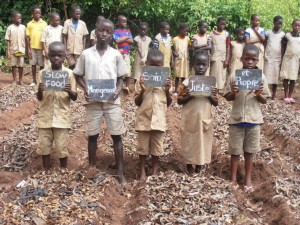
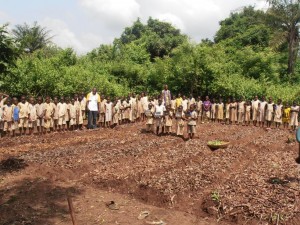
This school garden is found in D’Ifangni, in the Daagbé arrondissement of Djégou Nagot village. The soil in this 2,500 m2 area, is sandy and rich in humus and there is a borehole on hand acting as a water source.
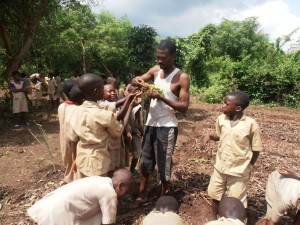
All 180 students in the school, of whom 75 are girls, work in the garden cultivating legumes, leafy vegetables, fruits and tubers which are used in part in the school’s cafeteria to ensure that the children eat high quality food, while the gardening activities in general help teach them about cultural know-how. Two professors guide the children as they cultivate, among other things: amaranth, vernonia, “gboman” (morel), Moringa, lemon grass, lettuce, tomatoes, peppers, eggplant, cucumbers, “lokoé”, carrots, sweet potatoes and cassava.
During the weekends 8 parents, 5 of whom are mothers, watch the garden and help the children with the more difficult activities. The women also cook for the children.
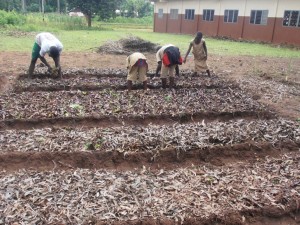
To conserve the soil, organic materials are regularly brought to the garden and mulched (which also involves recycling dead leaves from the trees) which then turns into humus. The mulch is spread out 5 cm thick over the plants, but animal droppings are also used as is compost (which consists in various strata ranging from five to ten cm of greens, brown plants, manure, ashes and forest sand) which also allows for the vegetable beds to be fertilized without forgetting the BRF (Ramial Chipped Wood).
In this garden both mixed cropping and crop rotation are employed, while all natural methods are used to fight off insects, like lemon grass, oxymum or basil on the borders of the beds, or even a few within the beds so as to keep the devastating insects away.
Area
Djégou Nagot Village, Daagbé arrondissement, Plateau department
Coordinator
Daniel Gaston Oke